
Are You Sitting in One of the Dirtiest Places You’ll Visit This Year?

Germaphobes look away. For everyone else, did you know that public spaces hold far more germs than any of us could ever imagine.
For example, in highway rest stops, you’ll see most people march right past the paper towels for the loud jet dryer because it feels modern and efficient, even though it’s not the cleanest choice for everyone standing nearby.
This example leads perfectly into a report by the Journal of Hospital Infection. A research team compared jet air dryers, hands-free air dryers and paper towels by coating freshly washed hands with harmless lactobacilli so they could track how far the microbes spread into the room.
Researchers in that study sampled the air 120 different times around each dryer and found that jet air dryers created roughly 4.5 times more airborne bacteria than warm air dryers and about 27 times more than paper towels.
Those numbers mean anything left on your skin is more likely to blow out into the shared air or land on nearby counters, and the University of Leeds put it plainly when they warned that jet air dryers spread more germs around washrooms than disposable paper towels.
These are the germiest public places:
1. Airplane cabins
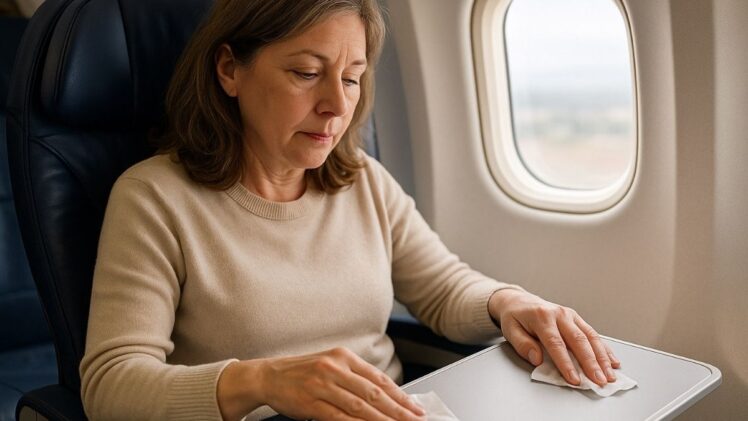
For those of us who travel regularly on airplanes, the cabins can feel especially close because you are strapped into a seat with strangers. ScienceAlert reported that data from Travelmath’s “Airline Hygiene Exposed” project showed tray tables carrying about 2,155 colony forming units of bacteria per square inch, far more than many toilet flush buttons or even a home toilet seat.
Families often spread snacks and phones across those trays, then rub their eyes or touch their faces without thinking, which gives whatever is left on the plastic a direct route toward mouths, noses and eyes.
Crew cleaning time between flights can be short, and Travelmath’s own summary pointed out that not every armrest, buckle and shade gets a deep scrub on each turnaround, so many travel sites now suggest bringing a few wipes and giving your seat area a quick clean.
2. Menus
This one might shock you (it shocked me, and it changed how I handle menus forever). Did you know that restaurant dining rooms look polished on the surface, yet the menu in your hand may be telling a different story, and Mashed notes that tests on restaurant menus have measured up to 185,000 microbes per square centimeter on those covers.
Parents who buckle kids into shared high chairs face another hidden hot spot, since a KOLD TV investigation with University of Arizona microbiologist Charles Gerba found fecal bacteria and even MRSA on many restaurant high chairs, which that station reported as a serious concern for families.
Personally, I always carry some bacterial wipes to handle menus, high chairs and condiment bottles when out and about, but I still wash my hands after ordering and before eating, because that one extra step is far easier than dealing with a stomach bug later.
3. Buses and trains
If you regularly use public transport, look away. Unsurprisingly city transit systems are filled with people touching the same rails, surfaces, and straps. An overview of public transport microbiomes in Frontiers in Public Health highlighted that human skin bacteria dominate those surfaces, with some systems also showing potentially risky strains.
Data from Travelmath’s “Public Transportation Hygiene Exposed” feature shows New York City subway handrails averaging around 2 million colony forming units per square inch, while other systems ranged from about 10 to a few hundred CFU.
Keeping a small bottle of hand sanitizer or wipes in your bag and avoiding face touching until you can wash up turns those crowded buses and trains into something you can manage, especially during heavy cold and flu seasons.
4. Restrooms
Finally, in a study looking at how a bathroom’s bacterial ecosystem returns after a deep clean, researchers fully decontaminated four public restrooms on a university campus, then watched what came back over time. According to research published in Applied and Environmental Microbiology, they focused on floors, toilet seats and soap dispensers, swabbing those spots hourly at first, then daily for several weeks.
UChicago Medicine noted that those swabs quickly picked up Staphylococcus, MRSA and several common viruses again, sometimes within just a few hours, showing how a restroom can look spotless while its invisible microbial community is already rebuilding.
Cleaning habits
For those of us in our 50s and beyond, the takeaway from all of this is simple. Wash your hands with soap, choose paper towels over jet dryers, and always clean your hands after touching trays, menus and grab bars. This is super-easy today as hand sanitizer and wipes are affordable and effective.
More About:Healthy Living